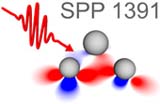
Optical nanocircuits consist of (i) optical antennas to efficiently excite specific local modes by far-field radiation, (ii) a small-footprint network of optical transmission lines (OTLs) to distribute and manipulate plasmonic excitations, and (iii) another set of optical antennas to efficiently convert local modes into propagating photons. The understanding of optical nanocircuits and a “systems approach” for their theoretical description in terms of discrete circuit elements, respective impedances and their interactions are fundamental for the realization and optimization of nano-optical devices and applications in areas such as sensing, (quantum) information processing, and nanometerscale coherent light sources.
We employ far-field spectral interferometry to fully characterize amplitude and phase of propagating plasmons that are transmitted through circuit elements in the form of ultrashort pulses. This enables us in particular to determine the group velocity of, e.g., plasmons on silver nanowires as a function of geometrical parameters.
Producing high-quality nanostructures, e.g., sophisticated circuit elements, is a very challenging task that we tackled by developing a method to fabricate single-crystalline gold flakes. In contrast to vapour-deposited multi-crystalline gold layers, these single-crystalline gold flakes allow for high-precision focused ion-beam milling.
Publications
Coherent Control of Plasmon Propagation in a Nanocircuit
C. Rewitz, G. Razinskas, P. Geisler, E. Krauss, S. Goetz, M. Pawłowska, B. Hecht, and T. Brixner
Phys. Rev. Applied 1 (2014) 014007
The miniaturization of optical devices is a prerequisite for broadband data-processing technology to compete with cutting-edge nanoelectronic circuits. For these future nano-optical circuits, controlling the spatial and temporal evolution of surface plasmons, i.e., propagating optical near fields at metal-insulator interfaces, is a key feature. Here, we design, optimize, and fabricate a nanoscale directional coupler with one input and two output ports, a device that is an essential element of nano-optical circuits. The directional coupler is based on a two-wire transmission line supporting two plasmonic eigenmodes that can be selectively excited. By manipulating the input polarization of ultrashort pulses and pulse pairs and by characterizing the light emitted from both output ports, we demonstrate open-loop ultrafast spatial and spatiotemporal coherent control of plasmon propagation. Because of the intuitive and optimized design, which exploits a controlled near-field interference mechanism, varying the linear input polarization is enough to switch between both output ports of the nanoscale directional coupler. Since we exploit the interference of a finite spectrum of eigenmodes, our experiments represent a very intuitive classical analogue to quantum control in molecules.
Multimode plasmon excitation and in-situ analysis in top-down fabricated nanocircuits
P. Geisler, G. Razinskas, E. Krauss, X.-F. Wu, C. Rewitz, P. Tuchscherer, S. Goetz, C.-B. Huang, T. Brixner, and B. Hecht
Phys. Rev. Lett. 111 (2013) 183901
We experimentally demonstrate synthesis and in situ analysis of multimode plasmonic excitations in two-wire transmission lines supporting a symmetric and an antisymmetric eigenmode. To this end we irradiate an incoupling antenna with a diffraction-limited excitation spot exploiting a polarization- and position-dependent excitation efficiency. Modal analysis is performed by recording the far-field emission of two mode-specific spatially separated emission spots at the far end of the transmission line. To illustrate the power of the approach we selectively determine the group velocities of symmetric and antisymmetric contributions of a multimode ultrafast plasmon pulse.
Spectral-interference microscopy for characterization of functional plasmonic elements
C. Rewitz, T. Keitzl, P. Tuchscherer, S. Goetz, P. Geisler, G. Razinskas, B. Hecht, and T. Brixner
Opt. Express 20 (2012) 14632
Plasmonic modes supported by noble-metal nanostructures offer strong subwavelength electric-field confinement and promise the realization of nanometer-scale integrated optical circuits with well-defined functionality. In order to measure the spectral and spatial response functions of such plasmonic elements, we combine a confocal microscope setup with spectral interferometry detection. The setup, data acquisition, and data evaluation are discussed in detail by means of exemplary experiments involving propagating plasmons transmitted through silver nanowires. By considering and experimentally calibrating any setup-inherent signal delay with an accuracy of 1 fs, we are able to extract correct timing information of propagating plasmons. The method can be applied, e.g., to determine the dispersion and group velocity of propagating plasmons in nanostructures, and can be extended towards the investigation of nonlinear phenomena.
Ultrafast plasmon propagation in nanowires characterized by far-field spectral interferometry
C. Rewitz, T. Keitzl, P. Tuchscherer, J.-S. Huang, P. Geisler, G. Razinskas, B. Hecht, and T. Brixner
Nano Lett. 12 (2012) 45
Spectral interferometry is employed to fully characterize amplitude and phase of propagating plasmons that are transmitted through silver nanowires in the form of ultrashort pulses. For nanowire diameters below 100 nm, the plasmon group velocity is found to decrease drastically in accordance with the theory of adiabatic focusing. Furthermore, the dependence of the plasmon group velocity on the local nanowire environment is demonstrated. Our findings are of relevance for the design and implementation of nanoplasmonic signal processing and in view of coherent control applications.
Atomically flat single-crystalline gold nanostructures for plasmonic nanocircuitry
J.-S. Huang, V. Callegari, P. Geisler, C. Brüning, J. Kern, J.C. Prangsma, X. Wu, T. Feichtner, J. Ziegler, P. Weinmann, M. Kamp, A. Forchel, P. Biagioni, U. Sennhauser & B. Hecht
Nat. Commun. 1 (2010) 150
Deep subwavelength integration of high-definition plasmonic nanostructures is of key importance in the development of future optical nanocircuitry for high-speed communication, quantum computation and lab-on-a-chip applications. To date, the experimental realization of proposed extended plasmonic networks consisting of multiple functional elements remains challenging, mainly because of the multi-crystallinity of commonly used thermally evaporated gold layers. This can produce structural imperfections in individual circuit elements that drastically reduce the yield of functional integrated nanocircuits. In this paper we demonstrate the use of large ( > 100 μm2) but thin ( < 80 nm) chemically grown single-crystalline gold flakes that, after immobilization, serve as an ideal basis for focused ion beam milling and other top-down nanofabrication techniques on any desired substrate. Using this methodology we obtain high-definition ultrasmooth gold nanostructures with superior optical properties and reproducible nano-sized features over micrometre-length scales. Our approach provides a possible solution to overcome the current fabrication bottleneck and realize high-definition plasmonic nanocircuitry.
Subwavelength broadband splitters and switches for femtosecond plasmonic signals
A. A. Reiserer, J.-S. Huang, B. Hecht, and T. Brixner
Opt. Express 18 (2010) 11810
Numerical simulations and an analytic approach based on
transmission line theory are used to design splitters for nano-plasmonic
signal processing that allow to arbitrarily adjust the ratio of transmission
from an input into two different output arms. By adjusting the geometrical
parameters of the structure, either a high bandwidth or a sharp transmission
resonance is obtained. Switching between the two arms can be achieved by
modulating the effective refractive index of the waveguide. Employing the
instantaneous Kerr effect, switching rates in the THz regime are potentially
feasible. The suggested devices are of interest for future applications in
nanoplasmonic information processing.
Analytic coherent control of plasmon propagation in nanostructures
P.Tuchscherer, C. Rewitz, D. V. Voronine, F. J. García de Abajo, W. Pfeiffer, and T. Brixner
Opt. Express 17 (2009) 14235
We present general analytic solutions for optical coherent control of electromagnetic energy propagation in plasmonic nanostructures. Propagating modes are excited with tightly focused ultrashort laser pulses that are shaped in amplitude, phase, and polarization (ellipticity and orientation angle). We decouple the interplay between two main mechanisms which are essential for the control of local near-fields. First, the amplitudes and the phase difference of two laser pulse polarization components are used to guide linear flux to a desired spatial position. Second, temporal compression of the near-field at the target location is achieved using the remaining free laser pulse parameter to flatten the local spectral phase. The resulting enhancement of nonlinear signals from this intuitive analytic two-step process is compared to and confirmed by the results of an iterative adaptive learning loop in which an evolutionary algorithm performs a global optimization. Thus, we gain detailed insight into why a certain complex laser pulse shape leads to a particular control target. This analytic approach may also be useful in a number of other coherent control scenarios.
Deterministic spatiotemporal control of optical fields in nanoantennas and plasmonic circuits
J.-S. Huang, D. V. Voronine, P. Tuchscherer, T. Brixner, and B. Hecht
Phys. Rev. B 79 (2009) 195441
We show that laser pulse shaping techniques can be applied to tailor the ultrafast temporal response of
localized and propagating optical near fields in resonant optical antennas (ROAs) and plasmonic transmission
lines, respectively. Using finite-difference time-domain simulations followed by Fourier transformation, we
obtain the impulse response of a nanostructure in the frequency domain, which allows obtaining its temporal
response to any arbitrary pulse shape. To illustrate the potential of the method we demonstrate deterministic
optimal temporal pulse compression in ROAs with reduced symmetry, in a plasmonic two-wire transmission
line, and in a prototype plasmonic circuit combining propagation effects and local resonances. The method
described here will be of importance for the coherent control of field propagation in nanophotonic structures
and light-induced processes in nanoscopic volumes.