Ultrafast nanooptics
Plasmon coupling, propagation, and interference using femtosecond PEEM (Meyer zu Heringdorf)
The means by which the primary energy input of a femtosecond laser pulse at a surface is propagated in time and space, how it can be influenced, and how the propagating energy can be decoupled to yield an energy transfer to a nanostructure has important ramifications for many future applications. After the creation of the initial excitation by a femtosecond laser pulse, several qualitatively different propagation mechanisms are possible. The size, shape, defect density, and the chemical composition of the medium for the propagation will be decisive which of these mechanisms will be favoured.
In larger structures, propagation can proceed at the surface of the particles via surface plasmon polaritons. Surface plasmon polariton waves (SPPs), i.e., propagating charge density waves (transversal magnetic), are practically light waves that are confined to the surface of a dielectric wave medium and are of particular importance when energy must be propagated to, from, or across a nanostructure. SPPs can easily be created by light, they can be guided along a surface, and they can be converted back into light at a different location on the surface.
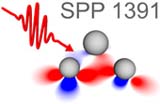
In this project of the SPP 1391, Two Photon Photoemission (TR-2PPE) is used to study the ultrafast properties of plasmon waves at surfaces. 2PPE PEEM of SPPs relies on plasmon enhanced photoemisison and provides a method to view a surface in the light of plasmon resonances. In such experiments, the propagation of the SPP with almost the speed of light is observed as a systematic shift of a characteristic (beat) pattern as a function of the delay time between pump-pulse and probe-pulse.
Recently the used PEEM has been upgraded to a Low Energy Electron Microscope (LEEM) with a three folded electron beam path. Now it is possible to shine the laser light in a normal incidence angle onto the surface, resulting in a sub-wavelength resolution of the SPP without any beating pattern. This gives the opportunity to observe SPPs more directly than before and to study reflection, interference and coupling of these.
